
Disclaimer: This review is based on publicly available information as of March 2026. Features, pricing, and capabilities may have changed. We encourage readers to verify current details directly with the vendor.
$350-500/month (estimated). Specialty-tuned for oncology. Enterprise-grade ambient AI documentation. That is DeepScribe in a nutshell — an enterprise-grade ambient AI scribe with deep specialty focus and pricing to match.
Here is what DeepScribe does and does not do:
- Does: Ambient listening, specialty-tuned AI models, AI coding (E/M, HCC, ICD-10), AI pre-charting, bidirectional EHR write-back, context-aware documentation, real-time clinical insights (DeepScribe Assist)
- Does not: AI receptionist, fax management, clinical AI chat
- Best for: Large health systems and oncology practices that need specialty-tuned documentation with enterprise-grade compliance
- Not for: Solo practices, budget-conscious providers, or clinics that need transparent pricing and full workflow automation beyond documentation
This review is an honest assessment of DeepScribe in 2026. We cover pricing, features, accuracy, EHR integration, HIPAA compliance, and how it stacks up against platforms that automate more of the clinical workflow.
This review was last updated in March 2026. Pricing and features reflect publicly available information at the time of writing. DeepScribe has expanded its feature set significantly since the original review — this update reflects those changes.
What Is DeepScribe?
DeepScribe is an ambient AI medical scribe designed for specialty-focused clinical documentation. Founded in 2017, the company has evolved from a scribe-only platform into what it calls an "Ambient Operating System" — combining AI-powered ambient listening with AI coding, AI pre-charting, and real-time clinical insights.
DeepScribe previously promoted a human quality assurance review layer that checked every note before delivery. As of early 2026, the company's website no longer prominently features human QA review as a core differentiator, and its product page states that notes sync to the EHR "in seconds." It is unclear whether the human review layer has been fully removed or repositioned as an optional feature.
DeepScribe has gained significant traction in the enterprise healthcare market, with deployment across more than 2,800 clinics and health systems. The platform has particular strength in oncology, where it has captured over 3.1 million cancer care visits per year and built specialty-tuned AI models trained on the nuances of cancer care documentation. Major health systems including Ochsner Health, Texas Oncology, Tennessee Oncology, and Pearl Health use DeepScribe as their documentation platform.
The company has earned recognition from KLAS Research with a 98.8 performance score and reports a 99.92% note satisfaction rating. DeepScribe has established partnerships with specialty EHR vendors including Flatiron Health's OncoEMR and Ontada's iKnowMed — reinforcing its position as an enterprise-first, specialty-focused tool rather than a general-purpose consumer product.
How DeepScribe Works
DeepScribe's workflow centers on ambient AI capture combined with specialty-tuned models and a growing suite of automation tools.
AI Pre-charting. Before the visit begins, DeepScribe's AI Pre-charting feature aggregates patient data from EHR records, referrals, labs, imaging, and prior visit summaries to create a structured pre-visit summary. This is a newer capability that was not part of the original product.
Start a visit. The clinician activates DeepScribe's ambient listening during the patient encounter. The platform captures the natural conversation between clinician and patient, with no need for dictation or structured prompts. DeepScribe's product pages show an iPhone interface, though specific iOS/Android platform availability is not explicitly confirmed on the current website.
The AI listens and extracts. DeepScribe processes the ambient audio in real time, using specialty-tuned AI models to identify clinically relevant information. The platform pulls forward relevant patient history from previous encounters — a context awareness feature that helps the AI generate more complete and accurate notes without the clinician needing to restate established diagnoses or ongoing treatment plans. DeepScribe Assist can also surface real-time clinical insights during the encounter, including HCC coding prompts and documentation requirements.
Note generation and delivery. DeepScribe's current product page states that notes sync to the EHR "in seconds" after the encounter ends, with an average chart closure time of 1.6 minutes. This represents a significant change from the company's earlier model, which routed every note through a human QA review team before delivery — a process that added hours of latency. It is unclear whether the human review layer has been fully retired or is now offered as an optional tier.
AI Coding. DeepScribe now includes automated E/M, HCC, and ICD-10 coding capabilities that generate code suggestions based on the clinical conversation and EHR context. The company reports a 34% increase in ICD-10 codes captured in implementations.
EHR integration. Once approved, notes can be pushed directly into supported EHR systems via bidirectional API integration — not just copy-paste. DeepScribe integrates with Epic, athenahealth, eClinicalWorks, AdvancedMD, drchrono, ModMed, and several specialty EHRs including iKnowMed (Ontada), OncoEMR (Flatiron Health), and others.
DeepScribe Pricing
DeepScribe does not publish pricing on its website. There is no pricing page, no self-serve sign-up, and no free trial. To learn the cost, you must request a sales demonstration and go through the enterprise sales process.
Based on available market reports and user feedback, DeepScribe pricing is estimated at $350-500 per month per provider. This places it at the premium end of the AI scribe market — roughly 3-4x the cost of consumer-focused alternatives.
There is no free trial available. Practices must commit to a sales consultation and demonstration before gaining access to the platform. For clinicians who want to test an AI scribe before committing, this is a significant barrier compared to competitors that offer self-serve trials.
Here is how DeepScribe's estimated pricing compares against a full-platform alternative:
| Plan | Price | Notes | EHR Write-Back | AI Coding | Key Limitation |
|---|---|---|---|---|---|
| DeepScribe | ~$350-500/mo (est.) | Unlimited | Bidirectional API | ✓ (E/M, HCC, ICD-10) | No free trial, enterprise sales only |
| DeepCura | $129/mo | Unlimited | Native API | ✓ (E&M integrity) | — Full platform included |
At an estimated $350-500/month, DeepScribe costs roughly 3x what DeepCura charges at $129/month. For that premium, you get specialty-tuned oncology models, AI coding, AI pre-charting, and DeepScribe Assist. What you do not get — and what DeepCura includes at $129/month — is an AI receptionist, fax management, clinical AI chat, the ability to choose your AI engine (GPT, Claude, or Gemini), and transparent self-serve pricing with a free trial.
DeepScribe Review: Key Features
Ambient Encounter Capture
DeepScribe captures clinical encounters using ambient audio processing, recording the natural conversation between clinician and patient without requiring dictation or structured input. The platform handles standard two-speaker encounters well and uses speaker diarization to distinguish between voices. The AI extracts clinically relevant information from the conversation flow and organizes it into structured documentation.
SOAP and Custom Note Generation
Notes are generated in standard clinical formats including SOAP notes, H&P, progress notes, and specialty-specific templates. DeepScribe's Customization Studio offers 50+ options to personalize clinical notes, and the system learns from clinician edits to improve future output. Note generation is tuned for specific specialties — particularly oncology, cardiology, gastroenterology, urology, orthopedics, and neurology — with documentation structures that reflect the unique terminology and workflow patterns of each discipline. Need templates before committing to an AI scribe? Start with our doctor's note template collection.
Quality Assurance and Note Delivery
DeepScribe historically promoted a human QA review layer that checked every note before delivery — a systematic review process rather than random sampling. However, as of early 2026, DeepScribe's website no longer prominently features human QA review as a core differentiator. The current product page states that notes sync to the EHR "in seconds" with an average chart closure time of 1.6 minutes. DeepScribe's Customization Studio — which learns from clinician edits to improve future notes — appears to have replaced or supplemented the human review layer as the primary quality mechanism, with the company reporting a 99.92% note approval rating.
Specialty-Tuned AI Models
DeepScribe has invested heavily in building AI models tuned for specific medical specialties. Oncology is the strongest focus area, with over 3.1 million cancer care visits captured annually feeding the training data for cancer care documentation. The platform also supports cardiology, gastroenterology, urology, orthopedics, and neurology with specialty-specific templates and AI models trained on the clinical language and documentation patterns of each field. The company also supports value-based care workflows as a distinct focus area.
Bidirectional EHR Integration
DeepScribe offers bidirectional API integration with major EHR systems, meaning notes and structured data can be pushed directly into the EHR without manual copy-paste. Supported systems include Epic, athenahealth, eClinicalWorks, AdvancedMD, drchrono, ModMed, and specialty EHRs including iKnowMed/Ontada, OncoEMR (Flatiron Health), and Objective Medical Systems. This is native API write-back — a meaningful advantage over competitors that rely on scraping-based or copy-paste workflows.
HIPAA Compliance and SOC 2
DeepScribe maintains HIPAA-compliant infrastructure and holds SOC 2 certification. For enterprise health systems with strict security requirements, the combination of HIPAA compliance and SOC 2 certification meets the baseline institutional security bar. Contact DeepScribe directly for current details on BAA terms, encryption standards, and data handling practices.
Mobile App Support
DeepScribe's product pages display an iPhone interface for encounter capture. Specific platform availability (iOS-only vs. cross-platform) is not explicitly stated on the current website. Practices should confirm Android availability directly with DeepScribe before committing.
Multilingual Support
DeepScribe reports support for 25+ languages for clinical documentation — a capability that was not part of the earlier product and expands its utility for multilingual practice environments.
What DeepScribe Does Well
Specialty-tuned AI models are a genuine differentiator. DeepScribe has invested heavily in building AI models trained on specialty-specific clinical data, with oncology as the clear flagship. With 3.1 million cancer care visits captured annually, the platform's cancer care documentation is backed by a depth of training data that generalist AI scribes cannot match. Oncology practices in particular will find that DeepScribe captures the nuances of treatment planning, staging, and multi-drug regimen documentation with less post-generation editing than generic alternatives.
AI Coding adds meaningful post-visit automation. DeepScribe now includes automated E/M, HCC, and ICD-10 coding — a significant expansion from its earlier scribe-only scope. The company reports a 34% increase in ICD-10 codes captured in implementations, which can translate to meaningful revenue recovery for practices that were previously undercoding.
AI Pre-charting streamlines visit preparation. DeepScribe's AI Pre-charting feature aggregates patient data from EHR records, referrals, labs, imaging, and prior visit summaries to create structured pre-visit summaries. This reduces the pre-visit preparation burden and helps clinicians walk into encounters already informed.
Broad EHR integration with bidirectional write-back. DeepScribe's native API integration with Epic, athenahealth, eClinicalWorks, AdvancedMD, drchrono, ModMed, and specialty EHRs is meaningfully deeper than the scraping-based or copy-paste workflows offered by many competitors. Bidirectional data flow — reading patient context from the chart and writing structured notes back — reduces manual data entry and supports a more seamless clinical workflow.
Context awareness pulls forward patient history. DeepScribe's AI pulls relevant information from previous encounters, including established diagnoses, ongoing medications, and treatment plans. This context awareness means the clinician does not need to restate known clinical facts during every visit — the AI incorporates them into the documentation automatically. For longitudinal care relationships common in oncology and chronic disease management, this feature reduces documentation redundancy.
Enterprise-grade security meets institutional requirements. The combination of SOC 2 certification, HIPAA compliance, and enterprise security practices satisfies the security review requirements of large health systems. For organizations like Ochsner Health and Pearl Health, passing institutional security review is a prerequisite that DeepScribe meets cleanly.
Strong enterprise traction validates the platform. Deployment across 2,800+ clinics and health systems — including Ochsner Health, Texas Oncology, Tennessee Oncology, and Pearl Health — demonstrates that DeepScribe can operate at enterprise scale. The KLAS Research 98.8 performance score, the 99.92% note satisfaction rating, and the Flatiron Health OncoEMR partnership provide third-party validation that goes beyond marketing claims.
 Screenshot: DeepCura UI — full dashboard with patient management, AI receptionist, notes, and automation.
DeepScribe Accuracy by Specialty
DeepScribe's specialty-tuned AI models mean that accuracy varies not just by encounter complexity, but by how heavily the platform has invested in each specialty's training data:
- Oncology: This is DeepScribe's strongest area by a wide margin. With 3.1 million cancer care visits captured annually, the platform has purpose-built models for cancer care documentation — treatment planning, staging, multi-drug regimens, and tumor board summaries are handled with the depth that oncology documentation demands. The company reports a 99.92% note approval rating and 85% clinician adoption across implementations.
- Cardiology: Strong performance with specialty-tuned models. Cardiac procedure documentation, hemodynamic assessments, and electrophysiology notes benefit from dedicated training data. Complex multi-vessel interventions may still require clinician review.
- Gastroenterology: Now listed as a supported specialty on DeepScribe's website, though the depth of specialty investment is not detailed as extensively as oncology.
- Primary Care: Supported via the Pearl Health partnership, though primary care is not DeepScribe's primary focus. Standard office visits are handled competently, but DeepScribe's pricing makes it a premium choice for what most primary care clinicians could accomplish with a less expensive tool.
- Urology / Orthopedics / Neurology: Supported with specialty templates and tuned models. These specialties benefit from DeepScribe's specialty focus, though the depth of training data is less extensive than oncology. Standard encounters are captured well; complex procedural documentation may require more editing.
- General / Family Medicine: Capable but not the primary focus. DeepScribe can handle general medicine encounters, but practices that primarily see routine office visits may find the enterprise pricing difficult to justify when less expensive alternatives perform comparably for this use case.
Where DeepScribe Falls Short
No AI receptionist or call handling. DeepScribe does not offer any patient communication automation. There is no AI receptionist to handle incoming calls, schedule appointments, triage patient requests, or manage prescription refill inquiries. Practices that want to reduce front-desk burden will need a separate solution. For options, see our ranking of the best AI medical receptionists in 2026.
No public pricing and no free trial. DeepScribe requires practices to go through an enterprise sales process before learning the cost or accessing the platform. There is no self-serve sign-up, no pricing page, and no trial period. For clinicians who want to test an AI scribe in their actual clinical environment before committing, this is a significant friction point. Most competitors — including platforms at a fraction of DeepScribe's price — offer free trials.
No fax management. Inbound fax processing, document routing, and fax-based referral management are not part of the DeepScribe platform. Practices that still receive a high volume of faxed records will need to handle this workflow separately.
No standalone clinical AI chat. DeepScribe Assist provides real-time clinical insights during encounters (such as HCC coding prompts and documentation requirements), but it does not appear to offer a general-purpose clinical AI chat for answering medical questions, reviewing evidence, or supporting clinical decision-making outside of the encounter context. Clinicians who want broad AI-assisted clinical reasoning should see our guide to the best ChatGPT for doctors.
No choice of AI engine. Clinicians cannot select which underlying AI model generates their notes. DeepScribe uses its proprietary model pipeline, and users have no ability to switch between different AI engines that may perform better for specific documentation styles.
Mobile platform availability is unclear. DeepScribe's product pages show an iPhone interface, but the current website does not explicitly confirm whether an Android app is available. Practices with Android-dependent clinicians should verify platform compatibility directly with DeepScribe.
Enterprise pricing may exclude small and solo practices. At an estimated $350-500/month per provider, DeepScribe's pricing is designed for health systems that can absorb the cost across large provider panels. Solo practitioners and small practices will find this price point difficult to justify, especially when full-platform alternatives like DeepCura offer ambient scribing, EHR write-back, an AI receptionist, billing automation, and more for $129/month.
Who Is DeepScribe Best For?
DeepScribe is a strong fit for a specific type of practice and organization:
- Large health systems and enterprise practices that need a proven, scalable documentation platform with institutional-grade security (SOC 2, HIPAA) and can absorb the premium pricing across a large provider panel.
- Oncology-focused practices that need specialty-tuned documentation for cancer care — treatment planning, staging, multi-drug regimen documentation, and tumor board summaries — where DeepScribe's 3.1 million annual cancer care visits provide unmatched training depth.
- Organizations that want AI coding alongside ambient scribing. DeepScribe's E/M, HCC, and ICD-10 coding automation adds meaningful post-visit value for practices focused on coding accuracy and revenue integrity.
- Organizations with dedicated IT for EHR integration setup. DeepScribe's bidirectional EHR integrations with Epic, athenahealth, eClinicalWorks, and specialty EHRs require IT configuration. Practices with dedicated technical staff will get the most from these integrations.
- Multi-specialty groups with complex documentation needs — particularly those with oncology, cardiology, gastroenterology, urology, or neurology departments that benefit from specialty-tuned AI models.
Who Should Consider Alternatives?
Not every practice will find DeepScribe the right fit. Consider looking at other platforms if you fall into any of these categories:
- Solo and small practices where $350-500/month per provider is prohibitive — especially when comparable or superior ambient scribing is available at a fraction of the cost.
- Clinics that want AI receptionist and fax management alongside documentation. DeepScribe does not automate reception, fax management, or payment collection.
- Budget-conscious providers who need a full-platform solution without enterprise pricing.
- Practices that want a simple, self-serve setup without going through an enterprise sales process. If you want to sign up, test the tool in your clinical environment, and decide — DeepScribe does not support that evaluation model.
If you need ambient scribing plus native EHR write-back, a 24/7 AI receptionist, fax management, and a choice of AI engine in one platform, DeepCura includes all of these for $129/month — less than a third of DeepScribe's estimated price, with instant note delivery and a free trial to evaluate before committing.
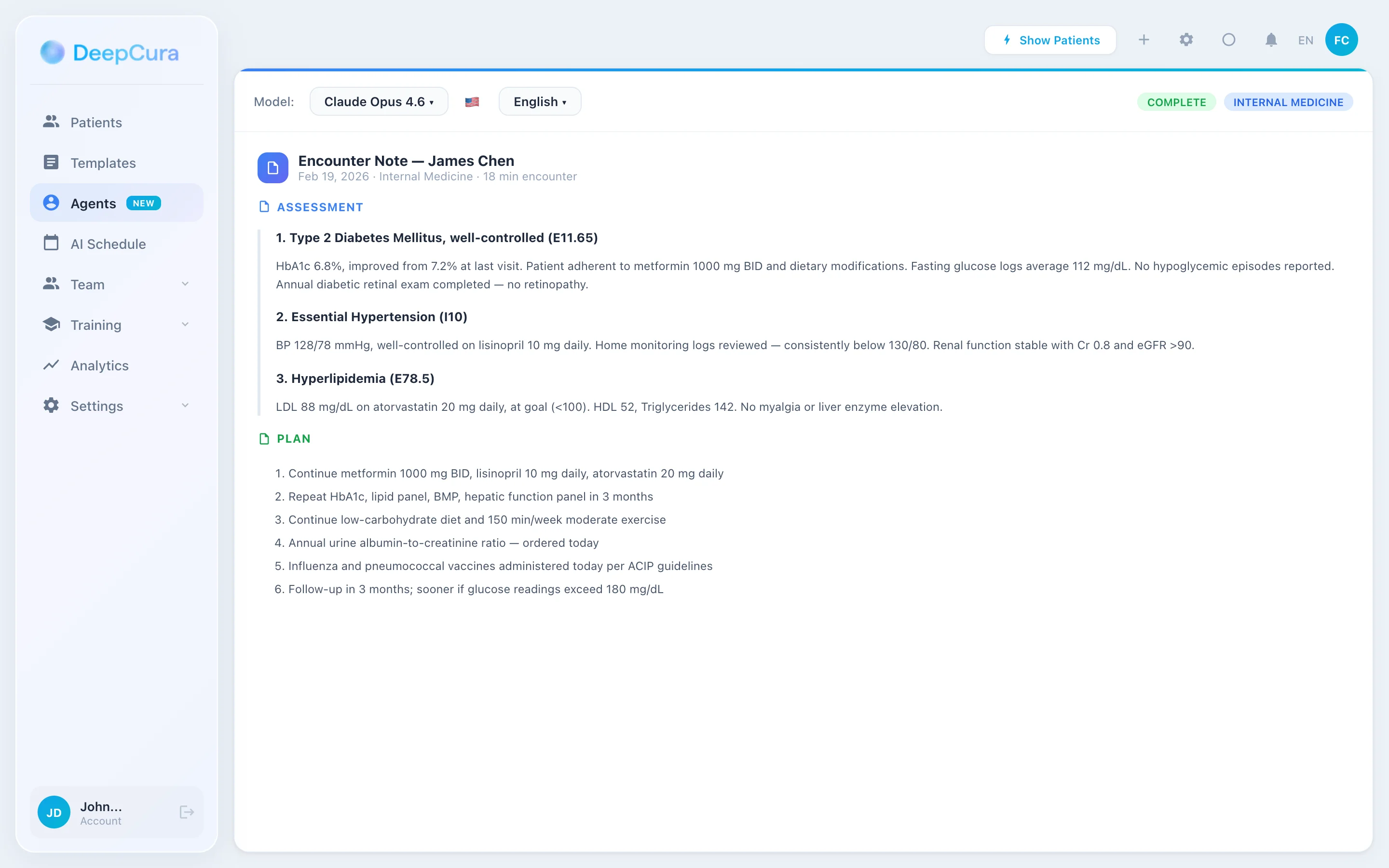 Screenshot: DeepCura UI — AI scribe with model selector for Claude, GPT-4o, or Gemini note generation.
DeepScribe vs Full-Platform Solutions
DeepScribe has expanded from a scribe-only tool into a broader ambient AI platform with coding, pre-charting, and real-time assist features. To evaluate whether that scope is enough for your practice, you need to see how DeepScribe compares across every phase — before, during, and after the visit.
Pre-Visit Automation
| Feature | DeepScribe | DeepCura |
|---|---|---|
| AI Patient Intake | ✗ | ✓ |
| AI Receptionist (Phone) | ✗ | ✓ |
| AI Pre-Charting | ✓ | ✓ |
DeepScribe now offers AI Pre-charting that aggregates patient data from EHR records, referrals, labs, and prior visits into a structured pre-visit summary. However, there is no AI receptionist to handle incoming patient calls for scheduling, triage, or prescription refill requests, and there are no automated patient intake forms. DeepCura's AI receptionist answers patient calls 24/7, handles scheduling and triage, and generates pre-visit summaries so the clinician walks into every encounter already informed.
During the Visit
| Feature | DeepScribe | DeepCura |
|---|---|---|
| AI Medical Scribe | ✓ | ✓ |
| Custom Note Templates | ✓ (specialty-tuned, 50+ options) | ✓ |
| 50+ Specialties | ✓ | ✓ |
| Real-Time Clinical Insights | ✓ (DeepScribe Assist) | ✓ (Clinical AI Copilot) |
| Clinical AI Chat (Copilot) | ✗ | ✓ |
| 25+ Languages | ✓ | ✓ |
This is where DeepScribe delivers its core value — ambient scribing with specialty-tuned AI. Both platforms offer scribing across 50+ specialties. DeepScribe Assist provides real-time coding prompts and documentation guidance during encounters. DeepCura delivers notes instantly and includes a clinical AI copilot for broader real-time clinical reasoning — differential diagnosis support, drug interaction checks, and evidence-based recommendations beyond coding prompts.
Post-Visit Automation
| Feature | DeepScribe | DeepCura |
|---|---|---|
| AI Coding (E/M, HCC, ICD-10) | ✓ | ✓ (E&M integrity) |
| EHR Integration (Native API) | ✓ (bidirectional) | ✓ |
| AI Prior Authorization | ✗ | ✓ |
| AI Referral Letters | ✗ | ✓ |
| AI Tasks & Alerts | ✗ | ✓ |
| AI Fax Management | ✗ | ✓ |
| AI Payment Collection (Stripe) | ✗ | ✓ |
DeepScribe now offers AI coding for E/M, HCC, and ICD-10 — a significant expansion from its earlier scribe-only scope. Combined with strong bidirectional EHR write-back, DeepScribe covers more of the post-visit workflow than it did previously. However, prior authorization, referral letters, fax management, and payment collection remain outside DeepScribe's scope.
DeepCura automates all of these post-visit workflows with dedicated AI agents. The billing agent validates E&M codes against note content to prevent downcoding and audit risk. The prior authorization agent drafts and submits requests. The fax management agent summarizes inbound faxes and routes them to the correct provider. For practices using EHR systems like athenahealth, see how the full AI workflow integrates with Athena.
Platform Capabilities
| Feature | DeepScribe | DeepCura |
|---|---|---|
| Choose AI Engine (GPT, Claude, Gemini) | ✗ | ✓ |
| Team Collaboration | ✓ | ✓ |
| Analytics Dashboard & Wellness | ✗ | ✓ |
| Estimated Starting Price | ~$350-500/mo | $129/mo |
DeepScribe locks clinicians into a single proprietary AI model. DeepCura lets practices choose between GPT, Claude, and Gemini — selecting the engine that performs best for their specialty and documentation style. DeepCura also includes an analytics dashboard that tracks documentation metrics, clinician efficiency, and practice wellness indicators.
For a direct side-by-side comparison, see our DeepCura vs DeepScribe breakdown.
See DeepCura in Action
Watch how DeepCura handles the full clinical workflow — from AI receptionist calls and patient intake through ambient scribing, automated billing, and native EHR write-back.

Frequently Asked Questions
Is DeepScribe HIPAA compliant?
Yes. DeepScribe is HIPAA compliant and holds SOC 2 certification. As with any clinical AI tool, HIPAA compliance is a shared responsibility — your practice must also ensure proper access controls, staff training, and configuration. Contact DeepScribe directly for details on their current BAA terms and encryption standards.
How much does DeepScribe cost?
DeepScribe does not publish pricing publicly. Based on available market reports, pricing is estimated at $350-500 per month per provider. There is no self-serve sign-up — practices must go through an enterprise sales consultation and demonstration to receive a quote. There is no free trial.
Does DeepScribe integrate with my EHR?
DeepScribe offers bidirectional API integration with Epic, athenahealth, eClinicalWorks, AdvancedMD, drchrono, ModMed, and specialty EHRs including iKnowMed/Ontada, OncoEMR (Flatiron Health), and Objective Medical Systems. The integration supports both reading patient context from the chart and writing structured notes back into the EHR. However, EHR integration setup requires IT configuration and coordination with DeepScribe's implementation team — this is not a self-serve process. For athenahealth users specifically, see our guide to the best AI scribe for athenahealth.
Is DeepScribe accurate?
DeepScribe's accuracy is reinforced by specialty-tuned AI models and its Customization Studio, which learns from clinician edits to improve future notes. The company reports a 99.92% note approval rating. Accuracy is strongest in oncology, where DeepScribe has the deepest specialty training data (3.1 million cancer care visits/year), and is strong in cardiology, gastroenterology, urology, and orthopedics. DeepScribe reports an average chart closure time of 1.6 minutes and 2.2 hours of documentation time saved daily in implementations.
Can DeepScribe handle specialty documentation?
Yes — this is one of DeepScribe's core strengths. The platform has invested in building specialty-tuned AI models for oncology, cardiology, gastroenterology, urology, orthopedics, and neurology, with additional support for value-based care workflows. Oncology is the flagship specialty, with purpose-built models trained on 3.1 million annual cancer care visits. The Customization Studio offers 50+ options to personalize clinical notes. Other specialties benefit from dedicated templates and tuned models, though the depth of training data is less extensive than oncology.
Does DeepScribe offer a free trial?
No. DeepScribe does not offer a free trial or self-serve sign-up. Practices must request a sales demonstration and go through the enterprise consultation process before gaining access. This is a significant difference from most competitors in the AI scribe market, which typically offer free trials ranging from 7 days to 30 days.
What are the best DeepScribe alternatives?
The best alternative depends on what your practice needs. DeepCura is a full-stack clinical AI platform that includes ambient scribing, a 24/7 AI receptionist, native EHR write-back, billing integrity checks, fax management, and patient intake for $129/month — less than a third of DeepScribe's estimated price. Freed AI offers the simplest AI scribe experience from $39-$119/month. Heidi Health is the strongest option for multilingual practices at $110/month. Nuance DAX Copilot provides the deepest Epic integration for large health systems at custom enterprise pricing. For a comprehensive comparison, see our Best AI Medical Scribes in 2026 ranking.
Is DeepScribe worth it?
For the right organization, yes. If you are a large health system or oncology-focused practice that needs specialty-tuned documentation with AI coding and deep EHR integration, and you can absorb the estimated $350-500/month per provider cost, DeepScribe delivers a level of specialty accuracy that most competitors do not match. However, for solo practices, small groups, or clinics that need transparent pricing and workflow automation beyond documentation and coding, the enterprise pricing and limited feature scope make DeepScribe a poor fit. At $129/month, DeepCura includes ambient scribing, EHR write-back, an AI receptionist, fax management, and instant note delivery — making it the better value for practices that need a full-platform solution.
Final Verdict
DeepScribe has evolved significantly from its origins as a scribe-with-human-QA into a broader ambient AI platform. Its oncology-tuned AI models — trained on 3.1 million annual cancer care visits — represent a depth of specialty investment that most competitors have not made. The addition of AI coding (E/M, HCC, ICD-10), AI pre-charting, and DeepScribe Assist extends the platform's value beyond pure documentation. For large health systems and oncology practices, these differentiators are meaningful.
Its remaining gaps are clear: there is no AI receptionist, no fax management, and no standalone clinical AI chat. There is no free trial, no public pricing, and no self-serve sign-up. The estimated $350-500/month per provider pricing is designed for enterprise health systems, not solo practitioners or small groups.
For clinicians evaluating their options, the decision comes down to scope and budget. If you are a large oncology practice that needs the deepest possible specialty documentation with AI coding and can accommodate the enterprise pricing and sales process, DeepScribe delivers. For practices that need transparent pricing, a full-platform solution with AI receptionist, fax management, and a choice of AI engine, DeepCura at $129/month offers ambient scribing, native EHR write-back, billing integrity checks, and more for less than a third of DeepScribe's estimated price.
Last verified: March 2026
Review our DeepCura vs DeepScribe comparison and our Best AI Medical Scribes in 2026 ranking to find the right fit for your practice. You can also read our reviews of Freed AI, Heidi Health, Abridge, and Suki AI to compare alternatives side by side.
References
[1] DeepScribe, "AI-Powered Ambient Medical Documentation," DeepScribe.ai. deepscribe.ai
[2] U.S. Department of Health and Human Services, "HIPAA for Professionals," HHS.gov. hhs.gov/hipaa/for-professionals
[3] U.S. Department of Health and Human Services, "Business Associate Contracts — Sample BAA Provisions," HHS.gov. hhs.gov/hipaa/for-professionals/covered-entities/sample-business-associate-agreement-provisions
[4] DeepCura, "AI Medical Scribe Platform — Ambient Scribing, AI Receptionist, EHR Integration," DeepCura.com. deepcura.com
[5] Capterra, "DeepScribe Reviews," Capterra.com. capterra.com/p/219563/DeepScribe/reviews
[6] KLAS Research, "DeepScribe Performance Rating," KLAS Research. klasresearch.com
[7] Ochsner Health, "Ochsner Health Partners with DeepScribe for AI-Powered Clinical Documentation," Ochsner.org. ochsner.org
[8] Pearl Health, "Pearl Health and DeepScribe Partnership," Pearl Health. pearlhealth.com
[9] MobiHealthNews, "DeepScribe Partners with Flatiron Health to Integrate with OncoEMR," MobiHealthNews. mobihealthnews.com